From Managing Work to Realizing Value
Rethinking how execution is governed.
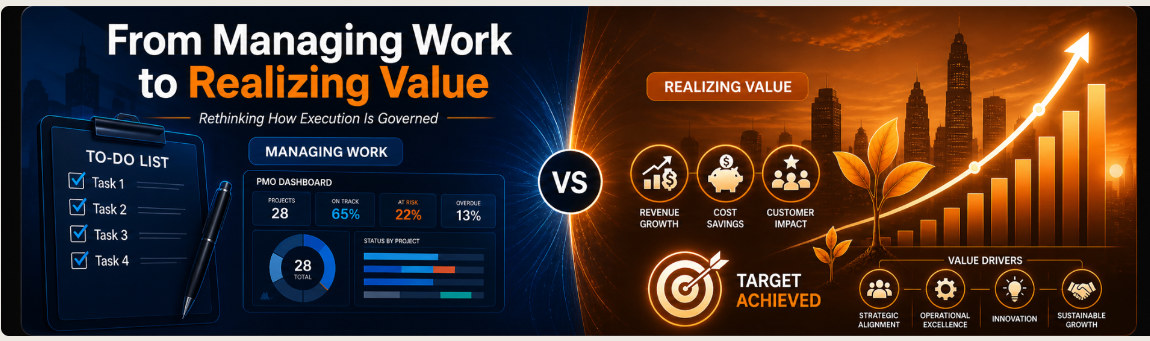
For most of my career and now as the founder of an Advisory firm, I have worked on the execution side of major initiatives , Post-Merger Integrations, Divestitures, Enterprise Transformations, Large Technology Programs, Manufacturing Consolidations.
And I keep encountering the same pattern across industries: companies establish formal execution structures to manage the work. A PMO for a major program. An IMO for an acquisition. An SMO for a divestiture. These offices are usually well run. Workplans are detailed. Milestones are tracked. Status is reported. On paper, everything looks great.
Then why are organizations not reaping close to 100% of the benefit they set out to achieve?
The data
- McKinsey: 70% of large transformation programs fail to achieve their intended outcomes
- Bain: 70–90% of M&A deals fail to deliver expected value
- Harvard Business Review: only 20% of strategic initiatives fully achieve their results
On a $100M Value Promise, the industry leaves $20–30M on the table. Teams spend hours reviewing milestone progress. Dashboards show task completion percentages. Risks and issues are discussed every week. The governance structures are extremely good at managing tasks , but not at ensuring the work produced the value it was meant to create.
A different discipline
This thinking led me to develop an approach I call Execution Value Realization. The idea is simple: once strategy has been defined and leadership has committed to execution, governance should focus on ensuring that the work actually produces the value it was intended to create.
Organizations today are very good at managing work. The next evolution is learning how to govern the value the work is supposed to deliver.