The Challenge
Following the acquisition of a complementary IT services provider, a large technology services company needed to integrate two product portfolios, delivery models, organizations, and technology environments without disrupting clients or jeopardizing revenue. The two companies had meaningful overlap across their service offerings, but differed in delivery models, pricing structures, client segments, organizational capabilities, and technology platforms. Leadership needed to determine:
- Which services should remain strategic?
- Which offerings should be consolidated or eliminated?
- Which capabilities and skills would be required by the combined company?
- Where could technology platforms be consolidated?
- How should the combined organization operate?
Interdependent Decisions
These decisions could not be addressed independently. Product strategy affected workforce requirements. Workforce decisions depended on the future operating model. The operating model depended on the technology architecture. All of this needed to be resolved before employee retention windows closed and client uncertainty began affecting the business.
1. Product and Services Portfolio
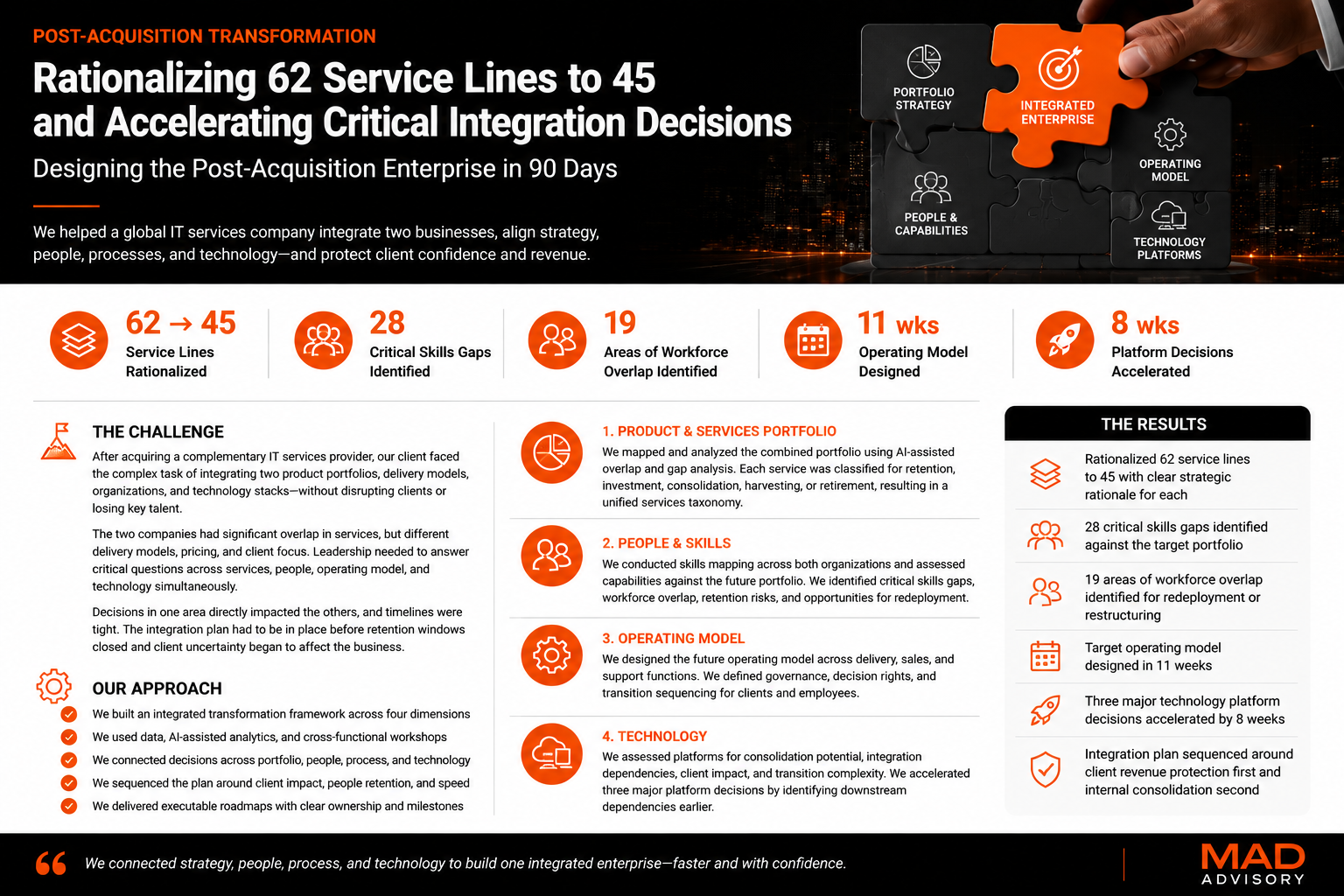
We mapped and analyzed 62 service lines across the combined portfolio, using AI-assisted overlap and gap analysis to identify duplication, differentiation, strategic importance, and future growth potential. We classified each service for retention, investment, consolidation, harvesting, or retirement, ultimately creating a unified portfolio of 45 service lines.
2. People and Skills
We conducted structured skills mapping across both companies and compared existing capabilities against the future services portfolio. Our analysis identified 28 critical skills gaps and 19 areas of workforce overlap requiring decisions around redeployment, restructuring, or retention.
3. Target Operating Model
We mapped delivery, sales, and support processes across both organizations and designed the future operating model. We defined governance, decision rights, escalation paths, and transition sequencing for clients and employees, completing the target operating model in 11 weeks.
4. Technology
We assessed the technology landscape for consolidation potential, integration dependencies, client impact, and transition complexity. By identifying downstream dependencies earlier in the process, we accelerated three major technology platform decisions by eight weeks.
Results
The integration was sequenced around client revenue protection first and internal consolidation second.
- 62 service lines rationalized to 45
- 28 critical skills gaps identified
- 19 areas of workforce overlap identified
- Target operating model completed in 11 weeks
- Three technology platform decisions accelerated by eight weeks
Business Impact
We helped leadership move from a collection of parallel integration workstreams to a coordinated post-acquisition transformation. By connecting portfolio, workforce, process, and technology decisions, we enabled leadership to make critical integration decisions earlier and communicate the future organization to clients and employees with greater confidence. Our roadmap provided a clear path to protect near-term revenue, retain critical talent, simplify the combined services portfolio, and systematically capture longer-term integration efficiencies.